Of course. Here is a comprehensive, SEO-optimized, and engaging blog post formatted in Markdown.
***
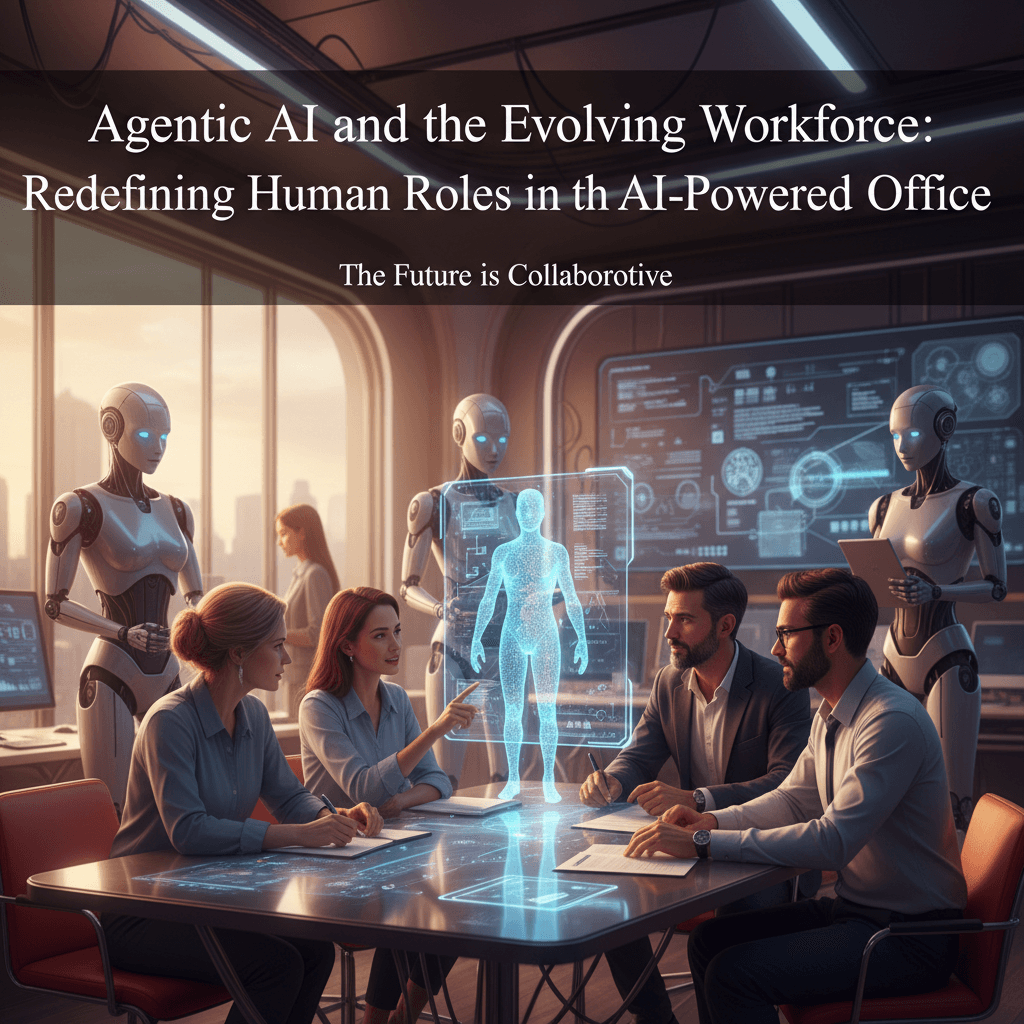
# Agentic AI and the Evolving Workforce: Redefining Human Roles in the AI-Powered Office

Remember the early days of the internet? It was a tool—a clunky, dial-up-powered library we occasionally visited. Today, it’s the invisible fabric of our lives. We are on the cusp of a similar transformation in the workplace, driven by a new force: **Agentic AI**.
If you think of AI like ChatGPT as a brilliant but passive intern waiting for your next command, then Agentic AI is the proactive project manager you just hired. It doesn’t just answer your questions; it takes your goals, breaks them down into tasks, uses tools to execute them, and reports back on its progress.
This isn’t science fiction. It’s the next wave of workplace evolution, and it’s poised to do more than just automate tasks—it’s set to redefine what it means to be a human professional. This article explores the rise of agentic AI, its impact on the workforce, and the exciting new roles emerging in the AI-powered office.
## What is Agentic AI, and Why is it Different?
To understand its impact, we first need to grasp what makes agentic AI a game-changer. It’s not just another app or a smarter chatbot; it’s a fundamental shift in how we interact with technology.

### Beyond the Chatbot: From Tools to Teammates
For the past few years, we’ve grown accustomed to AI as a tool. We prompt it, and it responds.
* “Write a marketing email for our new product.”

* “Summarize this financial report.”
* “Generate a Python script to sort this data.”
This is a reactive relationship. Agentic AI, however, is proactive. It operates with a degree of autonomy to achieve a high-level goal. You might give an AI agent a goal like:
**”Launch a digital marketing campaign for our new eco-friendly water bottle. Our target audience is millennials in urban areas, and the budget is $10,000.”**
An AI agent wouldn’t just write one email. It would:
1. **Plan:** Research the target audience, identify the best social media platforms, and create a content calendar.
2. **Execute:** Draft and schedule social media posts, write email copy, and even generate basic ad creatives.
3. **Use Tools:** Access the internet for research, use a calendar app to schedule posts, and connect to analytics platforms to monitor performance.
4. **Adapt:** Analyze early campaign data and suggest reallocating the budget to better-performing channels.
In this scenario, the AI isn’t a tool; it’s a digital teammate handling complex, multi-step projects.
## The Impact on the Current Workforce: Automation on Autopilot
With any powerful new technology comes the inevitable question: “Will it take my job?” The conversation around agentic AI is more nuanced. It’s less about job elimination and more about task automation and role augmentation.
### Which Roles Are Most Affected?
The roles most likely to be transformed are those heavy with repetitive, administrative, and data-coordination tasks. Think about the “work about work”—the endless cycle of scheduling, following up, compiling reports, and manually transferring data between systems.
* **Project Coordination:** AI agents can automatically track deadlines, send reminders, update project management boards, and generate status reports.
* **Data Analysis:** Compiling sales data from multiple sources into a weekly report can be fully automated.
* **Customer Support:** Basic inquiries can be handled end-to-end by an agent that can look up order information, process a return, and update the customer record.
* **Marketing Operations:** A/B testing email subject lines, scheduling social media content, and pulling performance metrics are prime candidates for agentic automation.
### The Augmentation, Not Elimination, Argument
History has shown that technology tends to augment human capabilities rather than simply replace them. The calculator didn’t eliminate mathematicians; it freed them from tedious arithmetic to focus on more complex theoretical problems.
Similarly, agentic AI will handle the operational drudgery, freeing human workers to focus on what they do best:
* **Strategy:** Setting the high-level goals and vision for the AI agents to execute.
* **Creativity:** Brainstorming novel campaign ideas and innovative solutions.
* **Relationships:** Building rapport with clients, negotiating complex deals, and leading teams with empathy.
* **Oversight:** Ensuring the work done by AI is high-quality, ethical, and aligned with company values.
## The Rise of New Human Roles in the AI-Powered Office
As AI agents become a common fixture in the workplace, a new ecosystem of human roles will emerge to manage, direct, and optimize them. These aren’t just modified old jobs; they are entirely new career paths built around human-AI collaboration.
### H3: The AI Orchestrator / Prompt Engineer
If a company has a team of digital AI agents, it will need a human conductor to lead the orchestra. The AI Orchestrator will be a strategic role focused on designing and managing complex workflows executed by multiple AI agents. They will be experts in defining clear goals, setting constraints, and ensuring different agents work together harmoniously to achieve a business objective.
### H3: The AI Ethicist / Governance Specialist
With autonomy comes risk. How do we ensure an AI agent making marketing decisions doesn’t inadvertently create a biased campaign? How do we guarantee an agent handling customer data complies with privacy laws like GDPR and CCPA? The AI Ethicist will be crucial for setting up guardrails, auditing agent behavior, and ensuring that automated processes are fair, transparent, and legally compliant. This role is essential for maintaining brand reputation and trust.
### H3: The Human-AI Collaboration Designer
This role sits at the intersection of user experience (UX) and process engineering. The goal is to design seamless workflows where humans and AI agents can pass tasks back and forth frictionlessly. They will answer questions like:
* What is the best interface for a manager to review and approve an AI-generated budget?
* How should an AI agent alert a human teammate when it encounters a problem it can’t solve?
* How do we design a system that feels like a true partnership, not just a human overseeing a machine?
### H3: The Specialized Trainer / Validator
While general AI models are powerful, they often lack deep, industry-specific nuance. A specialized trainer with decades of experience—a senior lawyer, a medical doctor, or a veteran engineer—will be invaluable. Their role will be to “teach” and fine-tune AI agents on specialized knowledge and, most importantly, to validate the AI’s output. For example, an AI might draft a legal contract, but a human lawyer will perform the final, critical review to catch subtle risks and ensure its enforceability.
## How to Prepare for the Agentic Future: Upskilling and Reskilling
The transition to an AI-powered office doesn’t have to be daunting. It’s an opportunity for growth. The key is to focus on developing the skills that are uniquely human and complementary to what AI can do.
### H3: Cultivating “Human-Only” Skills
* **Critical Thinking and Strategy:** AI can execute a plan, but humans are needed to create it. The ability to see the big picture, ask the right questions, and set a strategic direction is more valuable than ever.
* **Emotional Intelligence and Empathy:** Building relationships, mentoring team members, negotiating with partners, and understanding a customer’s true needs are all rooted in emotional intelligence—a domain where AI is still rudimentary.
* **Complex Problem-Solving and Creativity:** While AI can solve defined problems, humans excel at navigating ambiguity and generating truly novel ideas. The ability to connect disparate concepts and think “outside the box” will be a key differentiator.
* **Leadership and Communication:** Inspiring a team, communicating a vision, and building a strong company culture are fundamentally human endeavors.
### H3: Embracing Lifelong Learning
The most important skill of all will be adaptability. The tools and technologies we use will change continuously. Cultivating a mindset of curiosity and lifelong learning is the best way to stay relevant. Start playing with the AI tools available today. Understand their strengths and weaknesses. The more you treat AI as a collaborator you need to understand, the better prepared you’ll be for the future.
## Conclusion: A Partnership, Not a Replacement
The rise of agentic AI marks a pivotal moment for the modern workforce. The narrative of fear and replacement is giving way to a more optimistic vision of partnership and augmentation. By automating the mundane and the repetitive, AI agents will unlock human potential, allowing us to focus on the strategic, creative, and interpersonal work that drives real value and provides personal fulfillment.
The AI-powered office of the future isn’t one without people. It’s one where humans are empowered to do their best work, amplified by a team of capable, autonomous digital assistants. The time to prepare for this future is now.