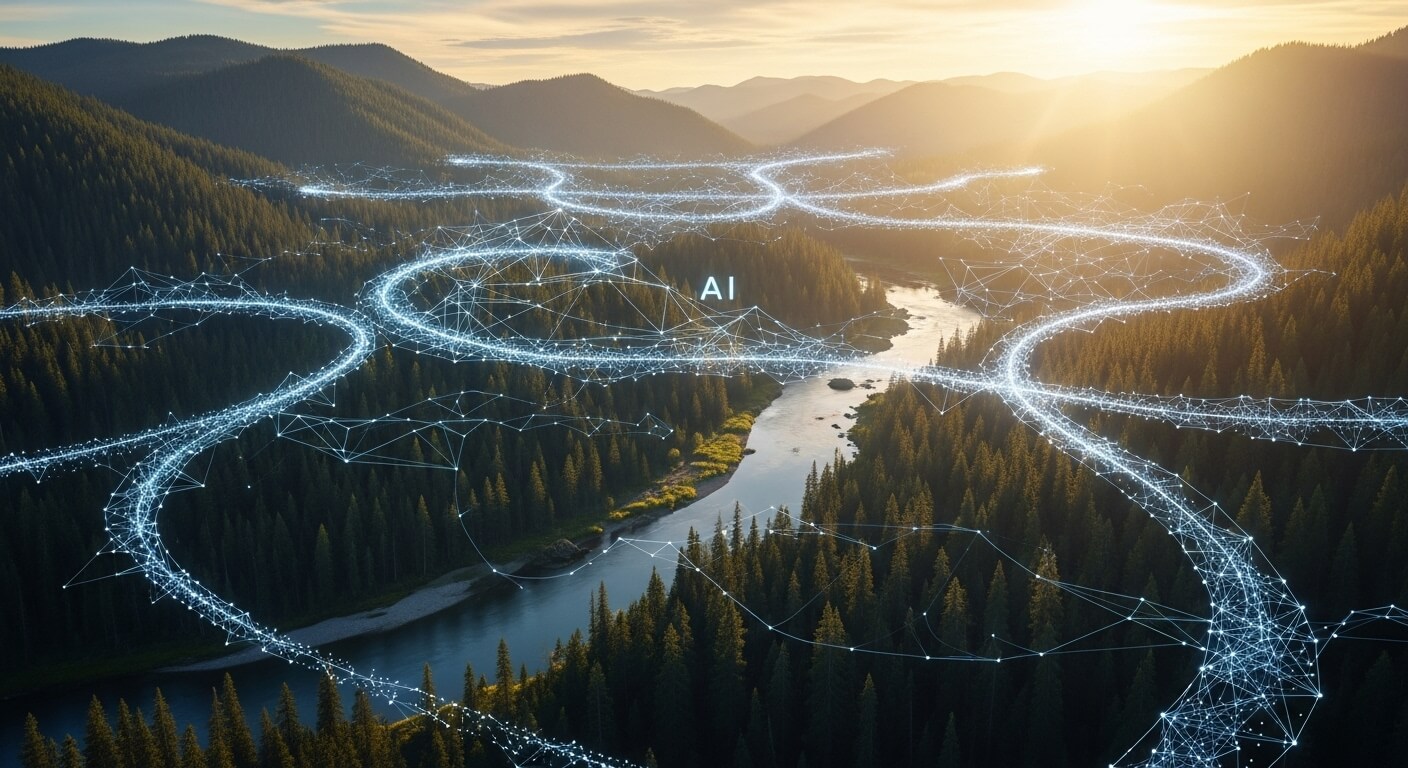

Remember when Artificial Intelligence felt like something straight out of a Hollywood sci-fi blockbuster? A distant, futuristic concept involving sentient robots and talking spaceships. Well, buckle up, because that future is arriving faster than a gigabit download. The AI revolution isn’t on the horizon; it’s unfolding in our daily lives, and its pace is accelerating at a breathtaking rate.
We’ve all had a taste of it, whether it’s asking ChatGPT to draft an email or using an AI art generator to create a wild image. But the latest breakthroughs go far beyond these initial “wow” moments. We’re talking about AI that can see, hear, and reason in ways that are fundamentally changing industries and redefining what’s possible.
If you’re feeling a mix of excitement and maybe a little bit of anxiety about it all, you’re not alone. In this guide, we’ll cut through the hype and the jargon. We’ll explore the most significant new AI advancements in plain English and, most importantly, break down what they actually mean for your job, your health, and your everyday life in the USA.
Beyond ChatGPT: The New Wave of AI Breakthroughs
While text-based models like ChatGPT captured the world’s attention, the latest developments are expanding AI’s senses and capabilities exponentially. This isn’t just an upgrade; it’s a whole new paradigm.
The Rise of Multi-Modal AI: More Than Just Words
One of the most significant leaps forward is the emergence of powerful multi-modal AI. In simple terms, this means AI can now understand and process information from multiple sources simultaneously—text, images, audio, and even video.
Think about it this way: older AI was like talking to someone on the phone. You could communicate with words, but they had no visual context. Multi-modal AI is like having a FaceTime call where the AI can see what you’re seeing and hear what you’re hearing.
For example, you could soon point your phone’s camera at the contents of your fridge, and an AI assistant could verbally suggest a recipe, show you a video of how to make it, and add the missing ingredients to your shopping list. This is the power behind models like Google’s Gemini and OpenAI’s GPT-4o, which are making human-computer interaction more natural and intuitive than ever before. This is one of the latest advancements in generative AI that is set to change how we interact with technology.

Generative AI Gets Hyper-Realistic
If you were impressed by the first wave of AI-generated images, the next generation will blow your mind. AI video generation tools, like OpenAI’s Sora, are now capable of creating short, stunningly realistic video clips from a simple text prompt. We’re talking about cinematic-quality scenes with complex camera movements and emotional character expressions, all generated from a few sentences.
While this opens up incredible creative avenues for filmmakers, marketers, and artists, it also raises important questions. The line between real and synthetic media is blurring, highlighting the growing need for digital literacy and tools to detect deepfakes.
AI as a Scientific Co-Pilot
Perhaps the most profound impact of the AI revolution is happening away from the public eye, inside research labs. AI is becoming an indispensable co-pilot for scientists, accelerating discovery at an unprecedented rate.
- Drug Discovery: AI algorithms can analyze massive biological datasets to identify potential new drugs and predict their effectiveness, slashing years off development timelines.
- Materials Science: AI is helping to design new materials with specific properties, from more efficient solar panels to stronger, lighter alloys for aerospace.
- Climate Modeling: Complex AI models are being used to create more accurate predictions of climate change, helping us better understand and mitigate its effects.
This isn’t about AI replacing scientists; it’s about augmenting their intelligence, allowing them to solve problems that were once considered impossibly complex.
So, What Does This All Mean For You?
Breakthroughs in a lab are fascinating, but how does this AI revolution translate to your life? The impact will be felt across the board, from the office to the doctor’s office.
Your Job Isn’t Disappearing—It’s Evolving
The number one question on everyone’s mind is: “How will AI affect my job?” The fear of mass unemployment is understandable, but the reality is more nuanced. History has shown that technology tends to transform jobs rather than eliminate them entirely. AI is less of a replacement and more of a powerful assistant.

Think of it as a force multiplier for your skills:
- For Marketers: AI can analyze market trends, generate dozens of ad copy variations in seconds, and personalize customer outreach at scale, freeing you up to focus on high-level strategy and creative direction.
- For Software Developers: AI coding assistants can write boilerplate code, spot bugs, and suggest optimizations, allowing developers to build better software faster.
- For Lawyers and Paralegals: AI can sift through thousands of legal documents in minutes to find relevant case law, drastically reducing research time.
The key is shifting from performing repetitive tasks to leveraging AI to enhance your strategic, creative, and problem-solving abilities.
A Revolution in Your Daily Life
The AI advancements are weaving themselves into the fabric of our daily routines. The “smart home” is about to get a whole lot smarter, with assistants that can truly understand context and anticipate your needs. Entertainment will become hyper-personalized, with streaming services that don’t just recommend what to watch but could one day generate content tailored to your specific tastes. The future of artificial intelligence in our homes is about seamless, helpful integration that makes life easier.
The Future of Healthcare is Personal
One of the most exciting frontiers is AI for personalized healthcare. Your unique genetic makeup, lifestyle, and medical history could be analyzed by AI to create truly customized health plans. We’re seeing the beginnings of this with:
- Early Disease Detection: AI is already proving to be incredibly effective at analyzing medical scans (like MRIs and X-rays) to spot signs of diseases like cancer earlier and more accurately than the human eye.
- Personalized Treatment Plans: AI can help doctors determine the most effective treatment protocol for a patient based on a vast array of data points, improving outcomes and reducing side effects.
- AI-Powered Wearables: Your smartwatch will do more than track your steps. It will continuously monitor vital signs and use AI to predict potential health issues before they become critical.
Navigating the AI Future: How to Stay Ahead
This rapid acceleration can feel overwhelming, but you have agency. You can be an active participant in the AI revolution, not just a passive observer. Here’s how to prepare.
Embrace Lifelong Learning
The most valuable skill in the AI era is the ability to learn and adapt. You don’t need to become a machine learning engineer, but developing a basic understanding of how to use AI tools is crucial. Spend time “playing” with free tools. Learn the basics of prompt engineering—the art of asking AI the right questions to get the best results.
Focus on Human-Centric Skills
While AI excels at data processing and pattern recognition, it struggles with uniquely human qualities. Double down on developing skills that AI can’t easily replicate:

- Critical Thinking and Complex Problem-Solving: The ability to analyze a situation from multiple angles and devise a creative solution.
- Emotional Intelligence and Empathy: Understanding and managing your own emotions and connecting with others.
- Creativity and Originality: Coming up with truly novel ideas and expressions.
- Leadership and Collaboration: Inspiring and guiding a team toward a common goal.
Ask the Right Questions (Ethical Considerations)
As we integrate AI more deeply into society, it’s vital to consider the ethical considerations of AI. We need to ask important questions about data privacy, algorithmic bias, and accountability. Being an informed citizen who understands these issues is just as important as being a savvy user.
Conclusion: Your Partner in a New Era
The AI revolution isn’t a distant event to be watched from the sidelines. It’s a dynamic, powerful force that is reshaping our world right now. The latest breakthroughs in multi-modal systems, generative media, and scientific research are not just technological marvels; they are tools that will redefine our work, enhance our lives, and help us solve some of humanity’s greatest challenges.
The future isn’t a battle of humans versus machines. It’s one of human-AI collaboration. By embracing a mindset of curiosity, continuous learning, and focusing on our irreplaceable human skills, we can navigate this exciting new era and harness the incredible potential of artificial intelligence to build a better future for everyone.

