[ad_1]
In recent times, the educational realm has undergone a significant transformation, greatly influenced by advancements in technology. Among these innovations, Augmented Reality (AR) emerges as a pivotal force, altering the dynamics of teaching and the learning experience for students. By superimposing digital elements onto the real world, AR creates interactive experiences that enhance understanding, engagement, and knowledge retention.

What is Augmented Reality?
Augmented Reality refers to technology that overlays computer-generated images, sounds, and other sensory information onto our real-world environment, thus creating a blended view that enriches our experience of reality. Unlike Virtual Reality (VR), which immerses users in a completely artificial setting, AR allows users to engage with both digital and physical realms at the same time. This unique characteristic makes AR a powerful educational tool, merging the tangible with the virtual and encouraging active learning.
Advantages of Augmented Reality in Education
1. Increased Engagement
A key benefit of AR in the educational field is its capability to capture and maintain students’ attention. Traditional teaching methods can sometimes result in passive learning, making it challenging for students to stay focused. In contrast, AR transforms learning into an interactive adventure. For instance, students can delve into complex subjects like biology or astronomy through 3D models they can manipulate. This degree of interaction not only sparks interest but also fosters a deeper connection with the content.
2. Better Understanding and Retention
Studies indicate that experiential learning enhances both comprehension and memory retention. AR supports this by enabling students to visualize abstract concepts in a more tangible way. For example, in a chemistry class, students can witness chemical reactions unfold in real-time through augmented simulations, converting theoretical knowledge into practical insights. These immersive experiences solidify concepts, making them easier to remember.
3. Customizable Learning Experiences
Every learner possesses distinct styles and paces of learning. AR technology allows for tailored educational experiences that adapt to the individual needs of each student. Learners can explore subjects at their own pace, revisit challenging lessons, and engage with materials aligned with their personal interests. Educators can use AR to develop custom learning modules that accommodate various learning preferences, thus promoting an inclusive atmosphere in the classroom.

4. Encouraging Collaboration and Social Interaction
AR enhances collaboration among students. Through shared AR experiences, learners can collaborate on projects, conduct experiments, or tackle problems together in a virtual space. This collaborative element not only cultivates teamwork but also boosts communication skills, which are vital in today’s interconnected society.
5. Connecting Theory to Practice
Numerous fields necessitate a combination of theoretical knowledge and practical execution. AR technology enables students to engage with real-world scenarios in a safe environment. In disciplines such as medicine, engineering, or even the arts, learners can practice skills and concepts through AR simulations, gaining valuable hands-on experience that prepares them for future careers.
Practical Uses of Augmented Reality in Education
A variety of educational institutions globally have begun to incorporate AR into their curricula, demonstrating its practical applications:
-
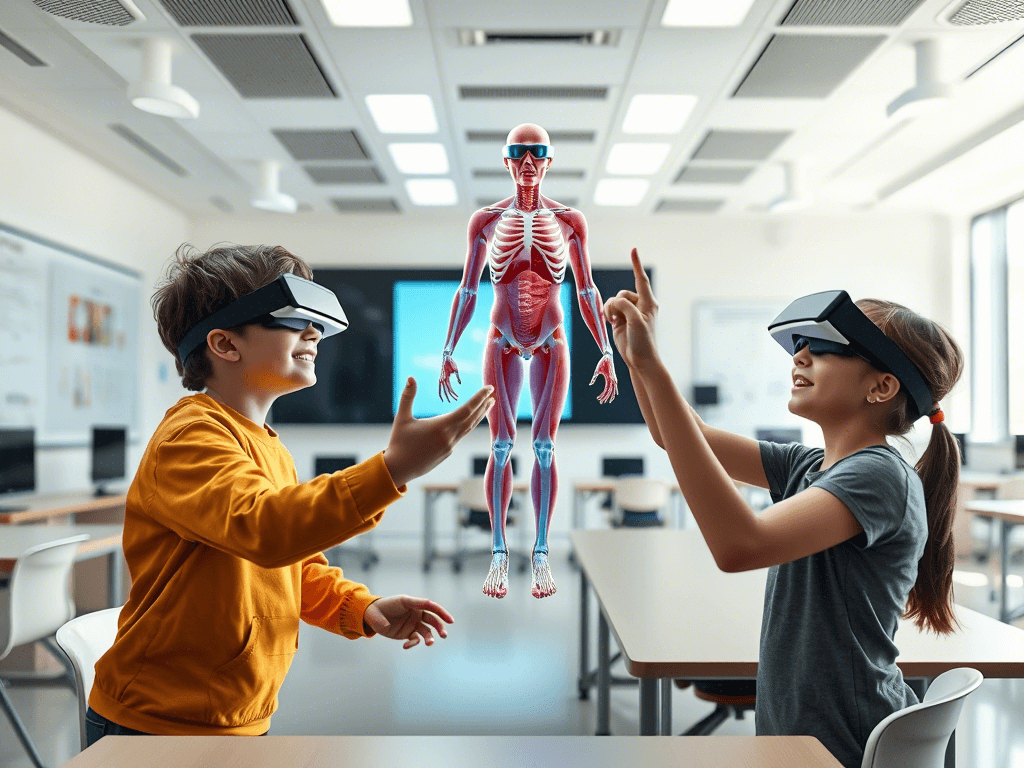
- Medical Training: Universities like the University of California, Davis, have created AR applications that allow medical students to examine human anatomy in 3D. By interactively visualizing organs and systems, students gain a better understanding of complex biological structures.
-
- History Lessons: AR has the ability to animate historical events. Applications such as “JigSpace” enable learners to explore historical occurrences and figures through interactive timelines and reconstructions, enhancing their grasp of the past.
-
- Language Acquisition: Platforms like “MondlyAR” leverage AR to immerse language learners in real-world situations, improving vocabulary retention and conversational abilities by facilitating interactions with virtual characters in varying contexts.
Challenges and Considerations
While the advantages of AR in education are numerous, the integration of AR presents certain challenges. Accessibility remains a concern—ensuring that every student, irrespective of their socio-economic background, can access AR tools. Furthermore, educators require adequate training to effectively implement AR in their teaching methodologies. Schools must also consider the long-term viability of AR technologies, including the associated costs of devices and software.
Final Thoughts
The use of Augmented Reality in education signifies a significant shift in how knowledge is shared and experienced. By boosting engagement, comprehension, and collaboration, AR encourages more profound learning experiences. As technology progresses, the possibilities for AR within classrooms globally are limitless. With thoughtful implementation, educators have the opportunity to harness AR’s potential to create enriching, inclusive, and innovative learning environments that equip students for a complex and rapidly evolving world. It appears that the future of education is not solely virtual—it is augmented.
[ad_2]